
How I Created 3, 2, 1 Piñata!

In February 2024, I decided to make a card game.
“It can’t be THAT difficult…right?”
I was doing what I usually do in the morning: surf the web. There are a couple of websites I like to view first thing. One of those websites is CNBC. My professional background is in corporate finance; I read CNBC because it covers financial news and there’s (mostly) no paywall. One aspect I like about CNBC is their "Make It" section. It focuses on success stories of regular, everyday people who succeed in business. From someone starting a business from scratch to someone describing how they mastered their niche, many of these stories strike a chord with me because I want to relate to their success. Who wouldn’t?!
In any case, I came across a story about an entrepreneur who made a card game. After reading the article, I was intrigued. Truth be told, I was more annoyed than intrigued. The intriguing part was seeing that an independent card game maker could sell so well on Amazon. I truly hadn't thought of card games as a business opportunity for the everyday person, and this person was doing great. I wondered though, were they embellishing their story to make themselves seem more successful than how it sounded? With my detective hat on and my coffee cup by my side, I did some “reverse engineering” Google searches. This product was crushing it on Amazon. I was both shocked and amazed. Thinking about this success, I started pondering about card games, in a general sense, and it stayed on the forefront of my mind.
I Like Playing Games
After reading about that person's journey, I started to think of my own hypothetical journey and how I’d go about things if it were me making a card game. I had mentioned that I was intrigued, but I was also annoyed the more I thought about it. Why? The more I learned about this person’s game, the more I started to see that it wasn’t truly a card game in the traditional sense. It’s printed on cards and there are action prompts you perform, but do those two things make it an actual card game? For me, when I think of card games, I think of games like Uno or Monopoly Deal, so it annoyed me that this card game wasn’t like these games conceptually, yet it was selling as a “card game”.
Does it really matter? Probably not to most people. But it lit a fire in me that I never intended to light. I've always been someone who just wants to play genuinely fun and engaging games — and that person's card game didn't exactly shout 'fun' when I read about it. So if I was going to make a card game, it was going to be one I'd actually want to play.
Coincidentally, my wife had just bought another card game she learned about called Taco, Cat, Goat Cheese, Pizza. She thought it’d be great to play with our six-year-old daughter. The game was fun, although a bit simplistic for my taste. I had never heard of this game before, but having recently read about the “card game” story on CNBC, I wondered how well this game was doing on Amazon. They too were crushing it.
It Got Me Seriously Thinking About Making a Card Game Myself
From all these events, it got me seriously thinking about making a card game myself. I liked playing games, so maybe I could create one too. While creating a game was never on my “Things To Do in Life” list, I started thinking maybe it should be.
More thoughts kept coming, and I eventually came to a conclusion. I’m going to make a card game and at no point was I going to settle for “I can’t do it”. Thus, the journey began.
Creating a Game Using Game Elements I Enjoy
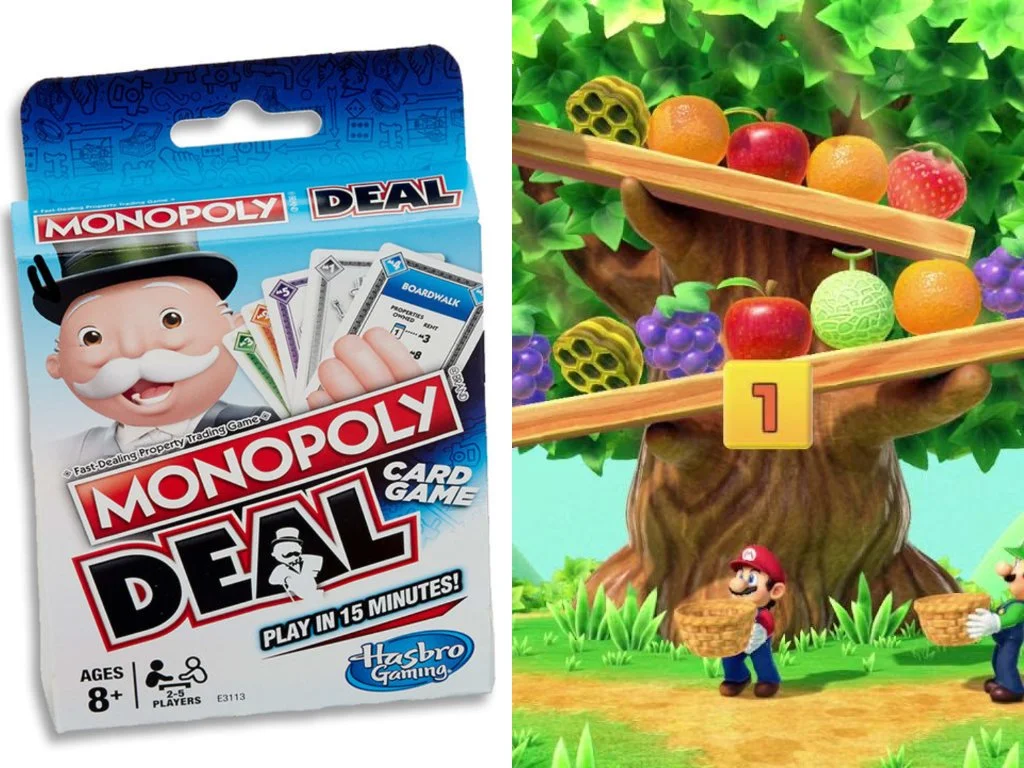
Monopoly Deal (left) and Honeycomb Havoc (right)
"This shouldn't be too hard", I thought. Sometimes I look back at this moment and think how silly a mindset that is. Although, it’s not necessarily a bad mindset to have.
I began to brainstorm and no doubt my past enjoyment of games came into play. The two games that do come to mind that helped influence 3, 2 1 Piñata! are Monopoly Deal and Mario Party.
The first game, Monopoly Deal (not an affiliate link), is a great card game you should play if you haven't already. It's not at all like playing the actual board game of Monopoly. It simply has Monopoly elements in the game, and to win, you have to earn three monopolies. I like how this game is designed, both gameplay-wise and illustratively. I also like how it plays quickly, but once you're done with a game, you immediately want to start another round. You also feel like you have agency in the game. While all good games possess an element of luck that you cannot control (which is great in my opinion), you can strategize and increase your chances of winning. Overall: you get to play the game > the game just plays you (i.e. Candyland or Chutes and Ladders type games).
The second game, Mario Party, is a Nintendo series that plays almost exactly like a board game, complete with mini-games sprinkled throughout. One mini-game in particular stuck with me: Honeycomb Havoc. The premise is simple — players take turns collecting fruit off a conveyor belt while trying to avoid honeycombs. You control a die that only rolls 1 or 2, so you're constantly calculating how to take the good stuff while engineering it so your opponents walk right into the bad stuff. It's a basic concept, but I love it. That tension of "I know what's coming, you know what's coming, but only one of us is getting the honeycomb" is exactly the kind of gameplay I wanted to capture.
If you've played 3, 2, 1 Piñata! and are familiar with the above games, you may see some similarities. Of course, 3, 2, 1 Piñata! is definitely different than those games.
I Have a Rough Draft
From the beginning, I had no idea what I was really doing. I was pretty much making it up as I was going along. At first, I was more concerned about the gameplay elements of the game. Is it compelling enough? Turns out, it was. The thing is, that’s not what made the game fun. It was only a small part of it.
In game testing, I noticed that all people really wanted to do was make life miserable for their opponents. Whether it was stealing their candy cards or even stopping someone from stealing candy cards, that is what got all the laughs (and minor anguish from the person who didn’t get their way).
While it’s easy enough to earn a candy card, sometimes it can take a while. The feeling you get when you see you have the right card to score a candy card feels great. Trust me, I see it all the time when people play. Yet, from all that gameplay, someone else can come right along and steal that candy card with Piñata Power. Occasionally, you’ll also see a great come from behind win and this is always fun to watch.
Whichever way the game plays out, it sort of comes down to “leave my candy alone…but, I’m going to take one of your candy cards, now.”
I knew I had something going. The game is starting to show signs of life, but it wasn’t quite there yet. The “flow” of the game was still off. I couldn’t quite figure out how to fix it until I got the help of a six-year-old.
The Help of a Six Year Old
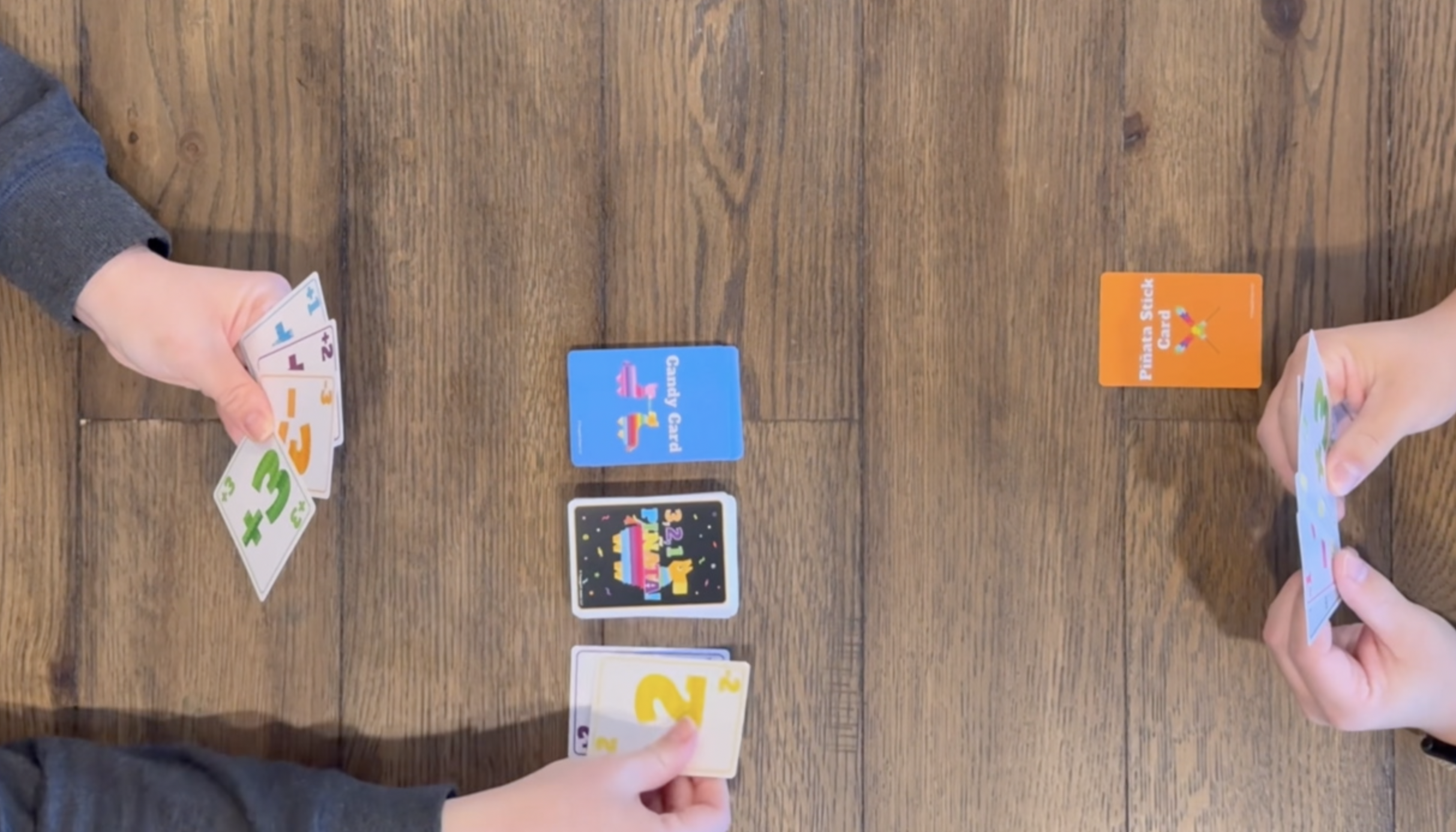
Over the course of several weeks, I was play testing the game (again and again) with my six-year-old daughter. After making some revisions, I’d be excited to test it out on her once more to see if things turned out better. Truth be told, she was tired of playing it. I still kept asking her in the hopes she’d change her mind and say yes to playing, and every once in a while she would.
The main sticking point of the game was "the count” mechanism. I couldn't get it to work. At this point, the count was more like a countdown timer. I was focused on having a type of countdown that starts at 10, and then seeing if players could strategically get it to exactly zero, which would result in that player scoring. It wasn't working, especially with my six-year-old.
Being six years old, our math skills are still in the developmental stage. We knew how to add and subtract, but it took a little while to think through the math process. Three minus two is one thing, but ten minus three is a little harder to do. The math eventually became overwhelming for her because it was just too much. Plus, the game didn't just subtract numbers; it also added them back to the "countdown timer". This was confusing for her and she struggled (adults struggled too for that matter, but more on the gameplay side than the math aspect). As we played, I was trying to help her add and subtract, and it just wasn't happening. And then it hit me.
In the middle of our game, I modified the rules. I said, "Instead of a countdown from 10, let's start at 5. You can decide if you want to add to get to 10 or subtract to get it to zero. How does that sound?”
It was a mostly indifferent reaction from her, but we agreed to try it. It worked. The game plays way better this way. The design of the game was just about complete, but there was still one last quirk I hadn’t quite resolved.
The Final Touches at RAGECon 2024
Development of the game took off from there. When I nailed down the game mechanics, it was only a matter of time to put all the final touches together. From the design and illustration of the game cards to finalizing the game rules, I had just about completed every hurdle I came across. Except one…I didn’t have a good way to keep track of “the count”.
The only solution I could come up with was assigning an official “Count Master” in the game rules so that this person would always keep track of where the count is at. This wasn’t my preferred choice, but I couldn’t think of a better solution. And that’s where a group of (very friendly and helpful) people at RAGECon 2024 helped me out.
At RAGECon 2024 (a.k.a. the Reno Area Gaming Convention), I demoed the game in front of complete strangers. People liked it and I received a lot of positive feedback. However, the same comment was repeated to me again and again. I was told people are going to forget where the count is at. How are you going to fix that? Suggestions ranged from adding additional, physical pieces or having computerized tokens to even changing the premise of the game. However, during one of the sign up sessions, a very kind group of family members played my game and took it upon themselves to figure out this issue. They came up with a simple, yet effective mechanism which I incorporated into the game: When someone scores a candy card from the count, remove that pile and start a new pile. Since the count always starts at 5, just recount the cards in the discard pile. Brilliant! I really appreciated their help, especially since they just did it because they wanted to. Moreover, every current and future player of 3, 2, 1 Piñata! appreciates what they did too.
The game was now fully complete.
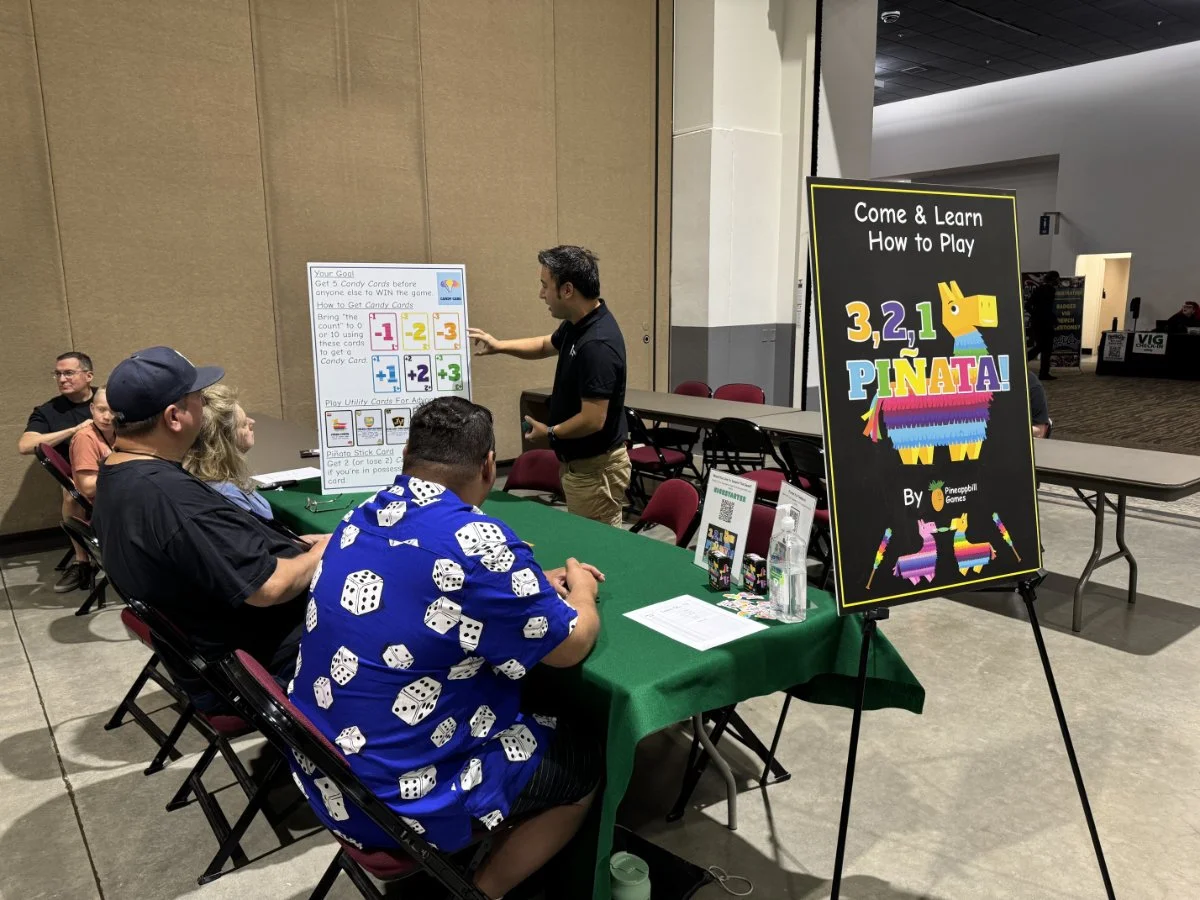
Demoing at RAGECon in 2024 - No, those aren’t the people who helped me with the final touches
The Exciting Journey That’s Just Getting Started
Many people have asked how I came up with the card game 3, 2, 1 Piñata!, and I hope this gives you more insight into my journey. There’s a lot more between-the-lines sort of information I could tell, but I don’t think it’s all that interesting to anyone other than myself.
The game is out in the world now, and watching people play it for the first time never gets old. The moment someone gets their candy stolen and just looks at the person who did it. That's the game working exactly as intended. The journey from a CNBC article to a finished card game was messier and more humbling than I expected, but I wouldn't change any of it.
If you’ve made this far in the story, I’ll share this fun tidbit with you. 3, 2, 1 Piñata! is actually the second idea I had for a card game, not the first. In trying to create a card game, I had various ideas I wanted to pursue. When I was in the rough draft phase, I didn’t want to get stuck to a single idea in case it didn’t pan out. Those other ideas are still out there. Whether they ever become anything, I honestly don't know yet.
If the game sounds like something you'd enjoy, you can grab a copy on Amazon.
Or if you want to try before you buy, the free print-and-play demo is a great place to start.